




Loot Boxes as Gambling-Like Reward Systems
 Milijana Komad / 6 min read
Keywords: Loot Boxes, Variable Ratio Reinforcement, Behavioral Psychology, Game Design, Monetization, Digital Economy
Abstract
Loot boxes have become one of the most influential and controversial mechanics in contemporary video game design. Positioned at the intersection of psychology, monetization strategy, and interactive entertainment, loot boxes operate through systems of chance that directly engage cognitive biases and reward circuitry. This paper examines the psychological foundations of loot boxes, their evolution within the gaming industry, and their increasing regulation as gambling-adjacent products. Drawing on behavioral economics, operant conditioning models, and real-world case studies, the analysis explores how random-reward mechanics shape player behaviour, influence spending patterns, and raise complex ethical and legal questions. By understanding the underlying structure and implications of loot boxes, designers can better evaluate their role in modern product ecosystems and the boundaries of responsible design.
Introduction
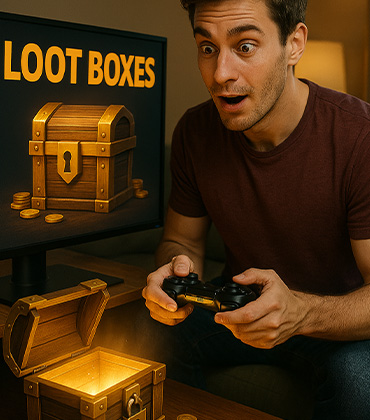
Loot boxes represent one of the most transformative and polarizing developments in modern game design. Defined as digital containers that award randomized items upon purchase or gameplay progression, loot boxes blend traditional game rewards with principles borrowed from gambling psychology, behavioural economics, and casino reinforcement models. What began as a minor mechanic in free-to-play titles has evolved into a global monetization framework generating billions of dollars annually.
The rise of loot boxes can be attributed to several overlapping forces: the shift toward live-service ecosystems, the demand for recurring revenue models, and the growing sophistication of behavioural design. Loot boxes activate powerful psychological mechanisms — including variable ratio reinforcement, near-miss effects, loss aversion, and reward anticipation — making them uniquely effective at shaping engagement and spending.
This paper dissects loot boxes from a product-design and psychological perspective, analyzing their structure, function, and societal implications. It concludes with an assessment of the ethical boundaries and future regulatory challenges surrounding this pervasive design strategy.
Exploring Loot Boxes: Concept and Structure
Loot boxes function as reward dispensers based on chance rather than guaranteed outcomes. Their design typically includes:
1. Randomized Reward Pools
Players receive items from a probability-weighted pool. High-value items are intentionally scarce, producing an uneven distribution of outcomes that fuels repeated purchases.
2. Tiered Rarity Systems
Color-coded rarity tiers (common, rare, epic, legendary) structure desirability and provide visual reinforcement. This hierarchy is foundational to player excitement and long-term engagement.
3. Purchase Pathways
Loot boxes may be earned through gameplay, purchased directly with real currency, or obtained using premium in-game currencies. This creates a fluid bridge between gameplay effort and monetary spending.
4. Visual and Auditory Reinforcement
Animations, sound effects, and dramatic reveals can heighten anticipation. Claims about dopamine responses to specific loot-box presentations require direct neurochemical evidence.
Through these structural elements, loot boxes create a dynamic environment where uncertainty becomes the driving force behind engagement.
Psychological Drivers Behind Loot Boxes
Loot boxes are powerful because they activate several well-established mechanisms in human cognition:
Variable Ratio Reinforcement
The most influential mechanism underpinning loot boxes is the variable ratio reward schedule — the same reinforcement model used in slot machines. Rewards are delivered unpredictably, making each opening feel like a potential breakthrough moment. This model is empirically proven to produce high levels of repeat engagement and resistance to stopping behaviour.
Near-Miss Effect
Near-misses — outcomes that appear close to delivering a high-value reward — intensify motivation rather than diminish it. Research shows that near-misses stimulate similar neural responses to actual wins, reinforcing the urge to “try one more time.”

Endowed Progress & Sunk Cost
Where a pity or collection system tracks progress toward a defined reward, partial completion may encourage continued play. Previous spending can also influence decisions through sunk-cost reasoning, but it does not by itself improve the odds of an independent draw.
Social Comparison & Status Reinforcement
Rare items obtained through loot boxes often function as virtual status symbols. Visibility of high-rarity skins or characters drives desire for social distinction, intensifying engagement loops.
Industry Case Studies
- 1. Overwatch (Blizzard Entertainment)
Overwatch popularized cosmetic loot boxes in mainstream gaming. Its system relied heavily on rarity tiers and engaging reveal animations. Despite being purely cosmetic, the impact on player behaviour was significant enough to spark global regulatory scrutiny.
2. FIFA Ultimate Team (Electronic Arts)
EA’s FIFA series showcases one of the most profitable loot box systems in the world. Players purchase “packs” containing randomized football players. Given the competitive nature of FUT, pack openings directly affect gameplay performance — linking monetization with competitive advantage.
3. Apex Legends (Respawn / EA)
Apex Legends integrates loot boxes (“Apex Packs”) with strong rarity-based systems. Although Respawn later published detailed drop rate tables to increase transparency, the game still relies heavily on variable reinforcement mechanics.
4. Genshin Impact (miHoYo)
Although technically closer to a gacha system, Genshin’s loot mechanics include pseudo-random reward pools, pity systems, and rotating banners. The structure maximizes anticipation while carefully controlling the probability of rare character acquisition.
Ethical Considerations and Global Regulation
Loot boxes have generated increasing concern among psychologists, regulators, and advocacy groups due to their similarity to gambling mechanics. Responses have included regulatory decisions, policy recommendations, studies, and public workshops:
The Netherlands
Regulatory treatment differs by jurisdiction and implementation. In the Netherlands, the Council of State ruled on 9 March 2022 that the FIFA packs at issue did not constitute a separate game of chance under the applicable law and overturned the penalty against EA. This ruling did not establish that all loot boxes are exempt from gambling law.
UK House of Lords (2020)
Recommended reclassification of loot boxes under gambling laws, citing strong correlations between loot-box spending and problem gambling symptoms.
Australia & New Zealand
Issued national studies highlighting behavioural risks, especially in adolescents.
United States
The FTC held a public workshop on loot boxes in August 2019 and published a staff perspective paper in August 2020, addressing transparency and consumer-protection concerns.

Despite these efforts, regulatory consensus remains fragmented. The global industry continues to debate where loot boxes fall on the spectrum between monetization, entertainment, and psychological risk.
Conclusion
Loot boxes represent one of the most sophisticated intersections of design, psychology, and monetization in the modern gaming landscape. Their reliance on randomized rewards, variable reinforcement schedules, and cognitive biases makes them both highly effective and deeply controversial. When implemented responsibly, loot boxes can serve as engaging optional systems within a game’s broader economy. However, without transparency, ethical grounding, or player protections, loot boxes risk crossing the boundary into exploitative design.
As the industry continues shifting toward live-service ecosystems and long-term revenue streams, understanding the psychological and structural impact of loot boxes is essential. Designers, regulators, and players must navigate this evolving landscape with an informed perspective — balancing creativity, profitability, and the responsibility to protect users from harm.
This article is part of a broader research series on behavioral manipulation in digital products.
For a comprehensive theoretical framework, see:
Engineering Behavior: Psychological Manipulation in Digital Products





Related posts

Digital Monetization

Behavioral Design
Grinding, Repetition, and Time-Based Progression Systems

Behavioral Design
Skinner Box Mechanics and Variable Reward Systems in Digital Products
DIGITAL DESIGN EXPERIENCE
MILIJANA KOMAD