




The Zeigarnik Effect and Designed Incompletion in Digital Products
 Milijana Komad / 10 min read
Keywords: Zeigarnik effect, product design, cognitive psychology, user experience.
Abstract
The Zeigarnik effect refers to better recall for interrupted than completed tasks reported in Bluma Zeigarnik’s research first published in 1927. Later findings have been mixed, and a 2025 meta-analysis found no overall memory advantage for unfinished tasks. Its possible implications for user engagement, motivation, and product design should therefore be treated as hypotheses rather than universal consequences.
This article reviews the Zeigarnik effect and considers possible applications in digital product and game design. The product examples are illustrative rather than controlled tests of the effect.
A focal point of this exploration is the gaming industry, where user engagement and retention are important. The article considers how unfinished tasks may interact with player motivation and engagement. Applying the Zeigarnik memory effect to these outcomes requires evidence beyond descriptions of game mechanics.
The game examples illustrate unfinished goals in contemporary products. They are not controlled tests of the Zeigarnik effect or evidence of its contribution to retention.
In essence, as we traverse the rich tapestry of the Zeigarnik Effect, we stand at the confluence of historical psychological insight, modern product design imperatives, and the ever-evolving dynamics of the gaming industry — weaving together a comprehensive scholarly discourse on a concept that continues to influence and inspire.
Introduction
Bluma Zeigarnik investigated memory for interrupted and completed tasks in research first published in 1927.
Bluma Zeigarnik , April 3, 1921 By Andrey Zeigarnik — https://www.flickr.com/photos/azeigarnik/48594447977/, CC0, https://commons.wikimedia.org/w/index.php?curid=99726888
Named after Bluma Zeigarnik, the Zeigarnik effect concerns a reported memory advantage for interrupted or unfinished tasks over completed tasks under particular conditions. It has been discussed in fields including advertising, education, and gaming, but this does not establish a universal effect in those settings.
Games can use interrupted or unfinished tasks to keep goals salient. Such designs may encourage some players to return, but continued participation is a motivational outcome that should be distinguished from the Zeigarnik memory effect and measured separately.
The Zeigarnik effect is also discussed in marketing, education, and product design. Possible effects on consumer behavior, learning, and continued product use should be evaluated separately from memory for interrupted tasks.
As we stand on the cusp of a century since Zeigarnik’s initial observations, the effect bearing her name remains as pertinent as ever. It acts as a beacon, illuminating our understanding of human cognition and its intricate dance with memory, task completion, and engagement. As scholars and practitioners, we continually delve into its depths, uncovering the myriad ways it shapes behaviours and experiences across diverse domains.
The Zeigarnik Effect: An Overview
Zeigarnik’s research on memory for interrupted and completed tasks was first published in 1927. Her experiments reported better recall for interrupted tasks under particular conditions.
One proposed explanation for the Zeigarnik effect is that an unfinished task creates task-specific tension. This theoretical account should not be treated as proof that unfinished tasks always produce better recall or a stronger motivation to continue.
Understanding the Zeigarnik Effect: A Psychological Perspective
Zeigarnik’s experiments reported better recall for interrupted tasks under particular conditions. Later findings have been mixed, and a 2025 meta-analysis found no overall memory advantage for unfinished tasks.
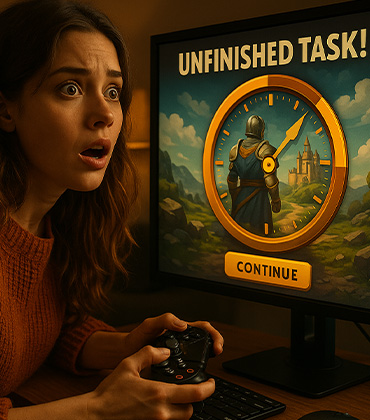
Understanding the human cognitive process, including phenomena like the Zeigarnik effect, enables product designers to create more engaging and user-friendly products. Unfinished tasks may remain salient or prompt some users to resume an activity. The tendency to resume interrupted tasks is distinct from the Zeigarnik memory effect, and its impact on product retention must be tested separately.

Zeigarnik Effect in Product Design
In product design, unfinished tasks and completion indicators may be used to encourage continued activity. A profile completion bar, such as one showing a profile as “85% complete,” illustrates this approach. Whether it improves recall, motivates completion, or changes retention through the Zeigarnik effect or other mechanisms must be tested separately.
Application in the Gaming Industry
Games can incorporate multi-stage tasks, intermittent rewards, and cliffhangers to encourage continued activity. Unfinished goals may remain salient between sessions, but this does not establish that all players continue thinking about them or that the Zeigarnik memory effect causes return play.
The Zeigarnik Effect in Gaming: Case Studies
Case Study 1: World of Warcraft (WoW)
WoW’s multi-part quests illustrate how unfinished goals can remain available across sessions. Whether this increases retention through the Zeigarnik effect, goal commitment, social interaction, or other mechanisms requires empirical testing.
Case Study 2: Candy Crush Saga
Candy Crush Saga includes short levels of increasing difficulty, and players may leave a level unfinished after unsuccessful attempts. This illustrates an unfinished goal that can be revisited; whether it increases engagement or retention through the Zeigarnik effect or other mechanisms requires empirical testing.
Case Study 3: The Legend of Zelda: Breath of the Wild
The Legend of Zelda: Breath of the Wild is an open-world game with side quests and exploration opportunities that can extend across sessions. These unfinished goals illustrate possible applications of task-completion theories; they do not demonstrate a measured Zeigarnik effect or establish the designers’ intention to exploit it.
Case Study 4: Fortnite Battle Royale
Fortnite Battle Royale’s battle pass provides tiers that players unlock through gameplay, with in-game rewards and further progress available across sessions. An unfinished progression track illustrates a continuing goal; it does not by itself establish that the Zeigarnik memory effect causes players to return.
Implications and Future Research Directions
The Zeigarnik effect presents potential opportunities and challenges for the gaming industry. On the one hand, it offers a mechanism to increase player engagement and motivation; on the other hand, it poses ethical considerations concerning the potential for exploitative game design.
Given the proposed relevance of the Zeigarnik effect to player behavior, it is crucial to explore this phenomenon further. Future research could focus on understanding how different game design elements and player characteristics interact with the Zeigarnik effect. Moreover, investigating ethical strategies for leveraging the Zeigarnik effect could provide valuable insights for developing player-centric game designs.
Conclusion
The Zeigarnik effect offers a theoretical starting point for considering memory and unfinished tasks in product and game design. It should be distinguished from motivation to resume an activity and from measured product retention. Incomplete goals may remain salient for some users, but their influence on return play is not universal and requires empirical testing.
The game examples illustrate how unfinished goals can appear in product design. They do not establish the designers’ psychological intentions or isolate the effect of those goals on engagement and retention.

However, as the gaming milieu continues its rapid evolutionary trajectory, the modalities of employing the Zeigarnik Effect are bound to metamorphose in tandem. This necessitates an ongoing dialogue and inquiry into its application, ensuring it serves the dual purpose of enriching the user experience while safeguarding against potential over-indulgence or dependency.
Furthermore, as the boundaries between disciplines become increasingly porous, the interweaving of psychological tenets into product design portends a future where user engagement is not a mere byproduct but a deliberately orchestrated outcome. This synergy between psychology and design serves as a testament to the limitless possibilities that lie at the confluence of understanding the human psyche and tailoring products to resonate with these inner workings. It’s paramount, however, to approach such integrations with a keen ethical compass, ensuring that while we leverage cognitive processes for engagement, we remain vigilant against the potential for undue manipulation or adverse repercussions.
This article is part of a broader research series on behavioral manipulation in digital products.
For a comprehensive theoretical framework, see:
Engineering Behavior: Psychological Manipulation in Digital Products





Related posts
Digital Monetization

Behavioral Design
Skinner Box Mechanics and Variable Reward Systems in Digital Products

Behavioral Design
Grinding, Repetition, and Time-Based Progression Systems
DIGITAL DESIGN EXPERIENCE
MILIJANA KOMAD